Every score comes with a graded reason.
A trust tier says how corroborated an insight is. A 1–5 quality score says how useful it is. Neither is a bare number: each dimension carries the sentence that produced it.
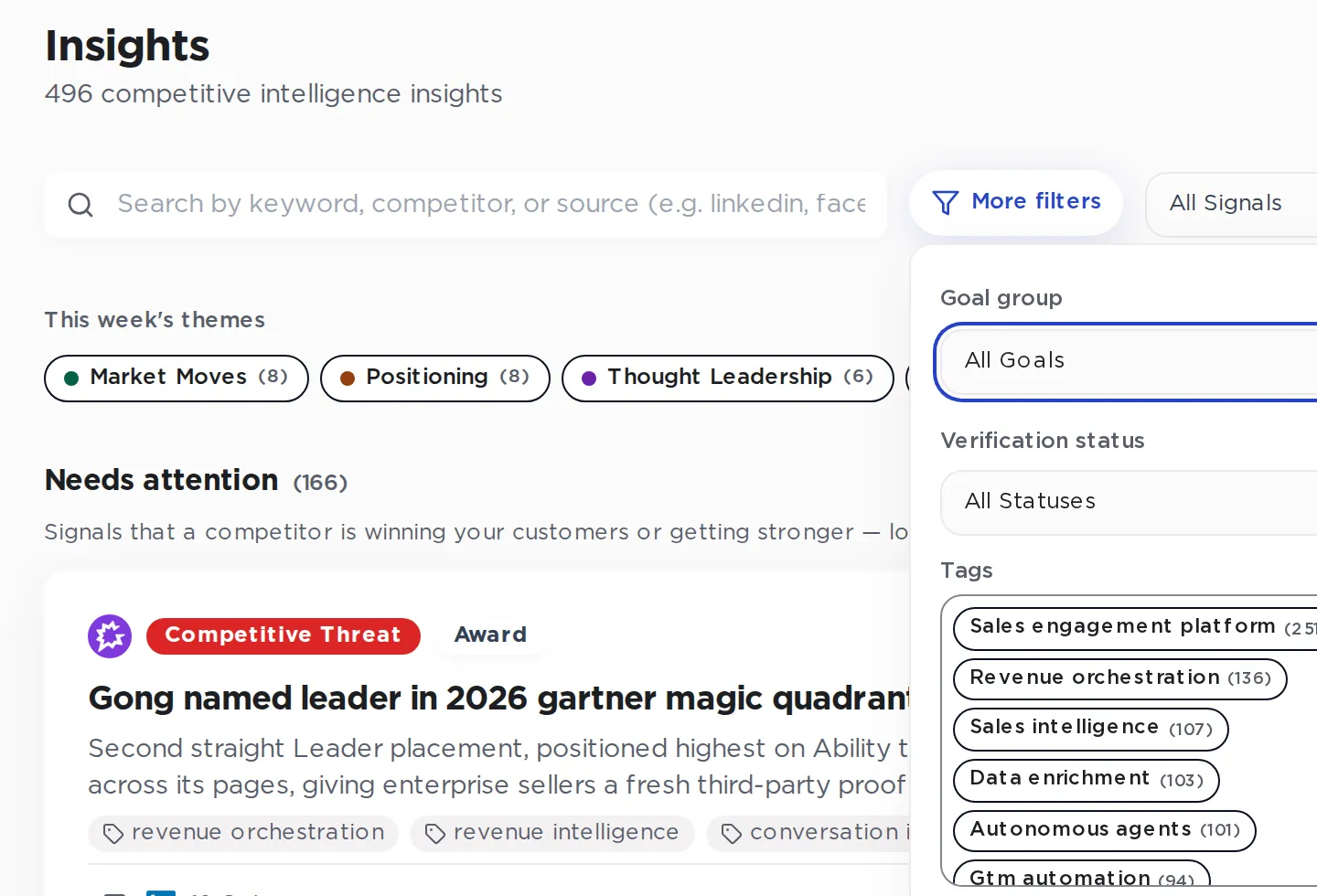
Verified, flagged or unverified, on every insight
The status travels with the insight, and you can filter by it.
- A status on every card
- Filter the feed by verification status
- Narrow further by goal group and tags
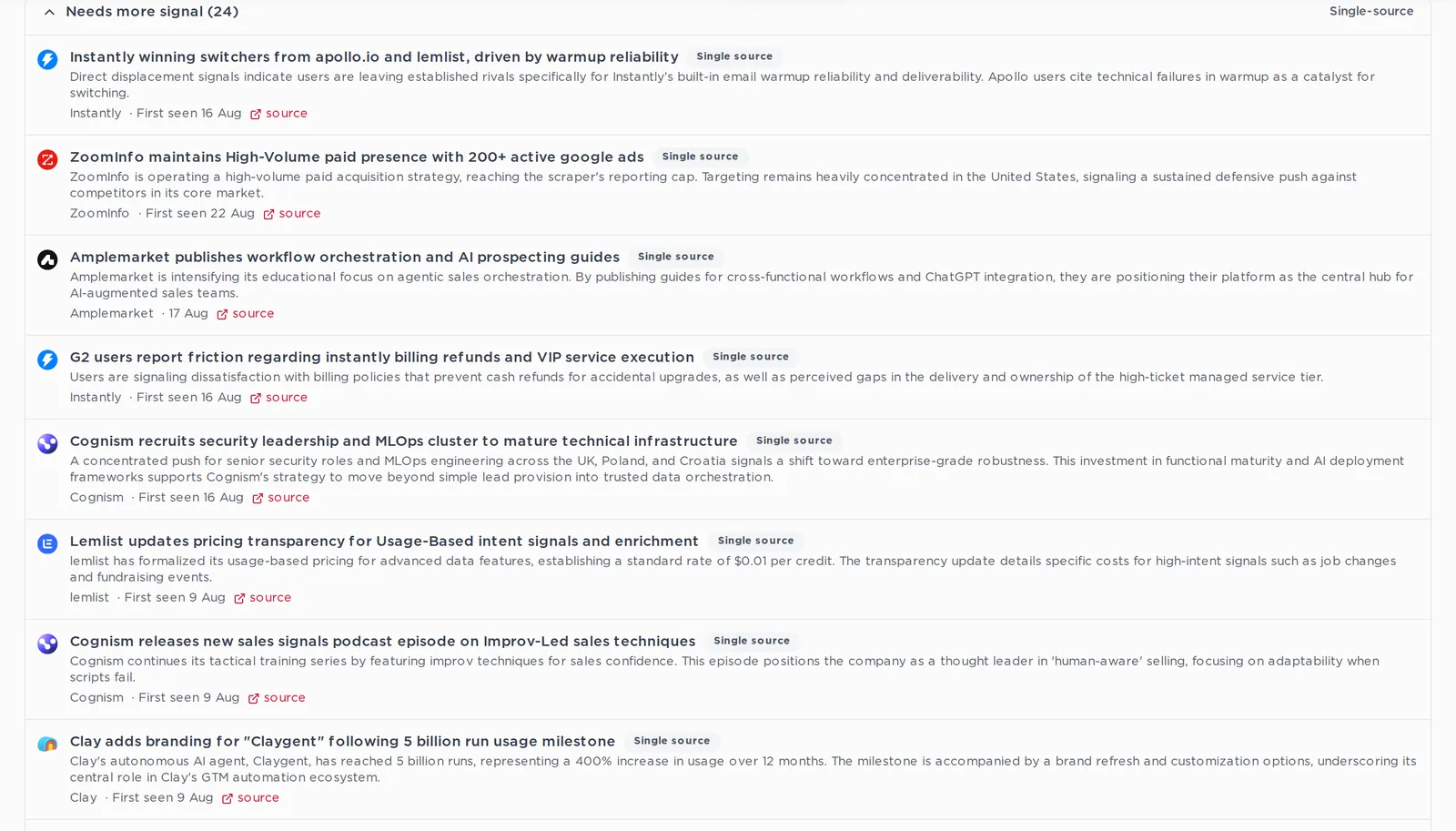
Single-source insights wait in their own list
One source is a lead, not a finding.
- Marked “Single source”
- Collapsed into their own section, apart from checked insights
- Each still links to the source it came from
How a tier is decided.
One question: how many independent sources back the claim. The checks can downgrade a tier before it ships.
What the checks stopped.
Every draft runs through 29 checks before it can reach you. Some reject it outright, the rest flag it for a closer look. These three were real drafts, left unnamed so the site never repeats a claim we threw out.
“A vendor removed a partner from its marketplace.”
The partner was missing from one capture of the page. The capture history showed it coming and going, so absence was not a change.
“A vendor expanded its MCP integrations.”
It came from the first capture of that page, with no earlier version to compare. Retracted when we tightened the rule, after it had passed.
“A vendor faces a security trust crisis.”
The draft cited no captured source at all. Unsourced claims are rejected automatically.
All 29 checks, in plain English: see the inspection docket.
Four grades, each with its reason.
The 1–5 score averages four grades, each with the sentence behind it. Real reasons, strong and weak:
✓“Named modules, EUR 40m figure”
✗“Vague bullet points, no data.”
✓“Battlecard ammo for displacement deals”
✗“Limited direct sales action”
✓“New AI modules and rebrand”
✗“Routine event presence, low signal”
✓“Directly traceable to WeLiveSecurity publication”
✗“Community estimates, not confirmed source data”
The confidence layer: common questions
What is the difference between trust tier and quality score?
Trust tier (Confirmed, Emerging or Unverified) is about credibility: how corroborated the claim is. The 1–5 quality score is about usefulness: specificity, actionability, novelty and evidence quality, each with a written rationale. A claim can be well-corroborated and still score low on usefulness, or vice versa.
What happens to low-scoring insights?
Unverified drafts never ship, and drafts that fail a hard check are rejected before they reach you. Confirmed and Emerging insights both ship, each labelled with its tier. A low quality score does not hide an insight; it tells you how much weight to give it, with the reasons written next to it.
Is the rationale written by a person?
No. It is generated per insight at scoring time, from the same evidence the score is based on, and published alongside the number rather than replacing it.
How scoring fits into the full pipeline →A score you can read the reasoning for.
Every insight in your briefing carries its tier, its score and the rationale behind both.
See how IndustryLens stacks up vendor by vendor
The confidence-scoring layer separates IndustryLens from sales-led CI tools. Read how it changes the buying conversation.