See the campaign, not just the ad.
Creatives come from public ad libraries, grouped into campaigns and filtered by competitor, funnel stage and channel: ad intelligence you can verify. Every ad shown is one the competitor actually ran.
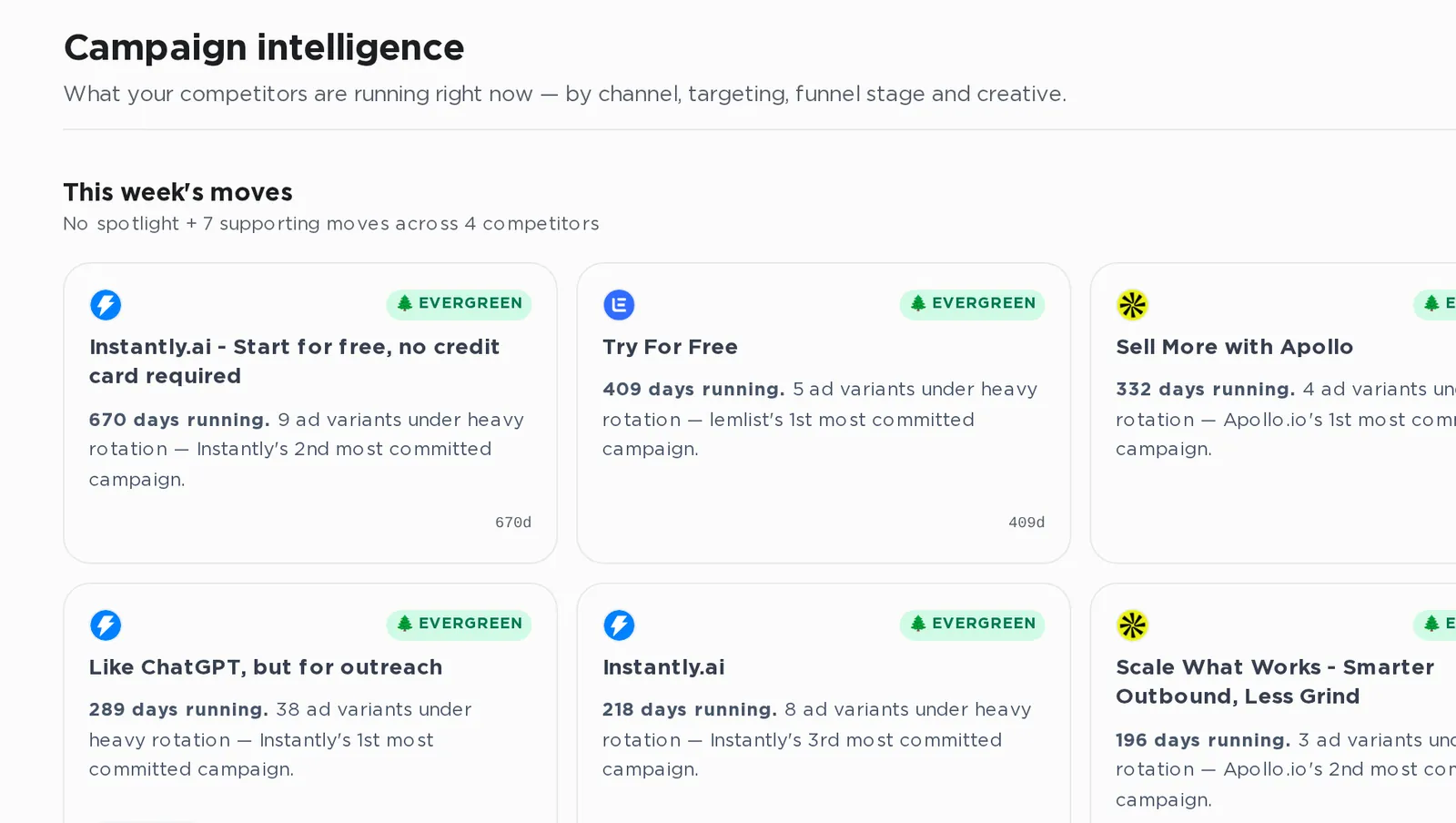
This week’s moves, campaign by campaign
The campaigns your competitors are running right now.
- How long each has run, and how many variants
- Evergreen campaigns flagged apart from new ones
- How committed the rival looks, against its other campaigns
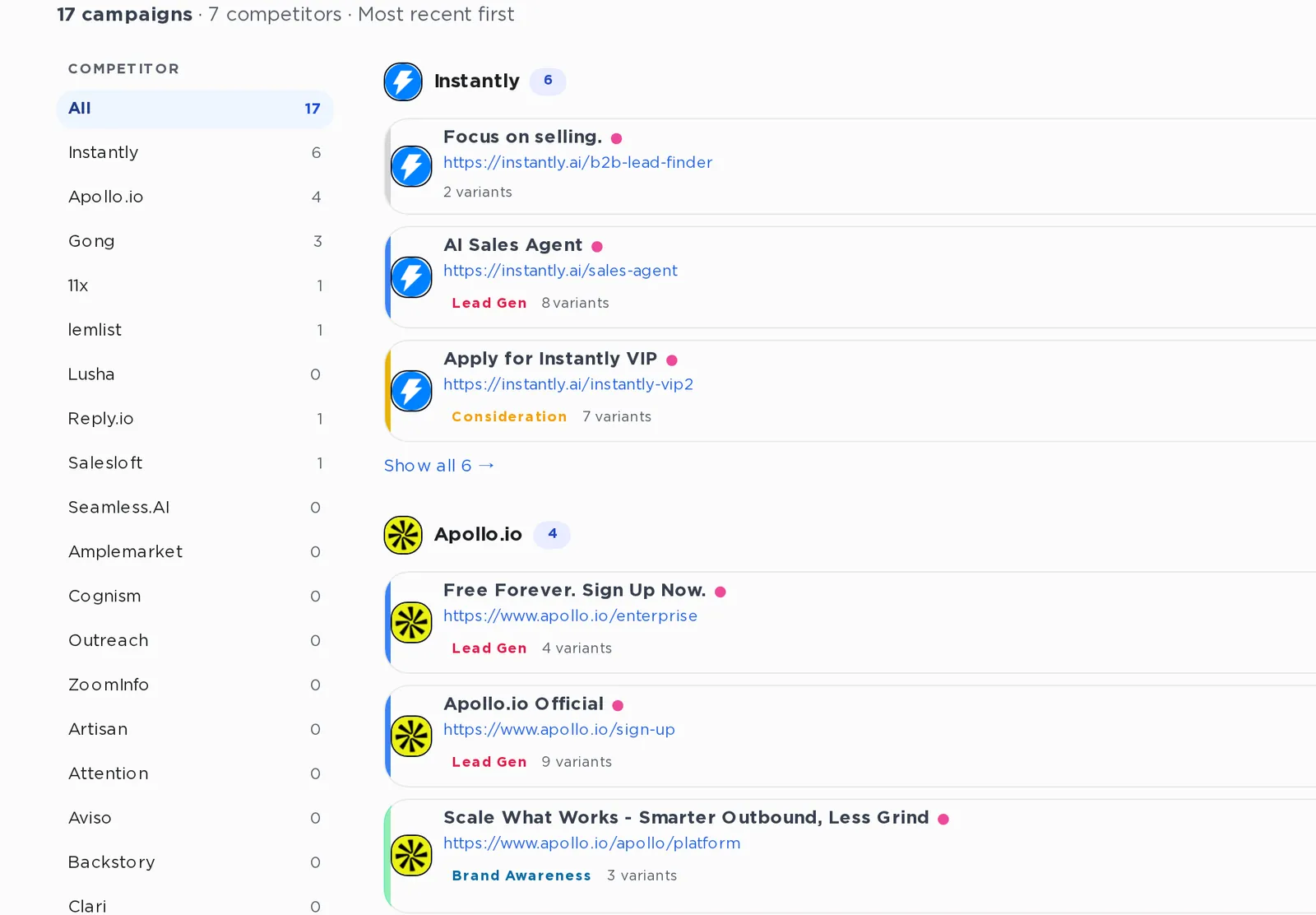
Every campaign, grouped your way
By competitor, funnel stage or channel.
- The landing page each campaign sends traffic to
- Funnel stage and variant count
- Filter by competitor, shown here on the left
- In the dashboard you can also narrow to active-only, or the last 90 or 180 days
Four moments in your month that go differently.
- Before a demo
Your AE doesn't walk in blind.
A competitor's new report ran as a 98-variant LinkedIn push last week. Your AE sees it Friday, opens with the counter-position instead of improvising mid-call. Cost without it: a demo, blindsided.
- Mid-deal
You see the pricing change first.
A free tier surfaces on a rival's hero page for the first time in months. The AE with that deal in negotiation gets a heads-up the same day, not after the prospect asks for a match. Cost without it: a reactive discount.
- Board update
You answer "are we losing share?" with data.
One competitor runs 106 ad variants for 43 days straight: not testing, scaling. That trajectory goes on the plan, not a guess. Cost without it: a board update built on vibes.
- Messaging review
You spot the mirrored playbook.
Two competitors run the same report with the same UTM content in the same week. You know which one is the original. Cost without it: a quarter chasing the wrong angle.
SampleThe shape of each moment is real; this cast is not.
Six things you've been doing by hand.
Most ad libraries dump raw creatives. This stitches them into the campaigns that produced them.
Surfaces enterprise tools don't.
Most competitive tools stop at the creative. We extract the strategic infrastructure behind it.
What the ad checks stopped.
Real campaign claims that never reached a briefing, and why. Vendors stay unnamed so we never repeat a count we had to pull back.
“A vendor is maintaining a 110-ad campaign.”
All 110 ads went live the same day the old ones stopped. That is ad rotation, not a running campaign.
“A vendor is scaling ads across three new countries.”
Every ad actually running was targeted at the US. The other countries were not in the live ad set.
“A vendor is running 400 active ads.”
The ad library shows at most 200 results per page. We hit that limit; we did not count 400 ads.
Every draft runs through 29 checks. See them all.
See how IndustryLens stacks up vendor by vendor
Campaign intelligence sits between competitive intelligence and sales engagement. Compare with both categories.